This is not only the ultimate banana bread but also the perfect vehicle for overripe bananas. It is based on a recipe that my mom used to make when my brother and I were growing up. I thought that chocolate chips were needed in an otherwise perfect cake. This cake freezes beautifully, so eat one now and freeze one to enjoy later.
Two 9- by 5-inch (2 L) metal loaf pans, lined with parchment or waxed paper, greased
In a bowl, combine flour, baking soda, and salt.
In a large bowl, using electric mixer, beat oil and sugar. Add eggs, one at a time, beating well after each addition. Add bananas and vanilla, beating well. Add flour mixture, beating just until smooth. Stir in chocolate chips and walnuts, if using.
Spread batter in prepared pans. Bake in preheated oven for 60 to 65 minutes or until a tester inserted into center of cakes comes out clean. Let cakes cool in pans on racks for 15 minutes. Remove from pans and let cool completely on racks.
Tip: You can easily freeze overripe bananas, skin and all. Just be sure to thaw them before mashing.
Although in Italy, biscotti is the term for cookie, here is a recipe that has become synonymous with the name biscotti. They are a wonderful dipping cookie or accompaniment to ice cream or sorbet.
Yield: 120 biscotti
3 cups plus 2 tablespoons all-purpose flour
1/2 cup unsweetened cocoa
2 1/4 teaspoons baking powder
3/4 cup (1 1/2 sticks) unsalted butter
1 3/4 cups granulated sugar
4 large eggs
Grated zest of 1 lemon
2 tablespoons coffee liqueur
1 cup bittersweet chocolate chunks
1 teaspoon kosher salt
1 cup whole blanched almonds, toasted
Preheat the oven to 325 degrees. Line 2 large baking sheets with parchment paper (or use nonstick baking sheets). In a large bowl, sift together the flour, cocoa, baking powder, and salt. In a large bowl of an electric mixer, beat the butter and 1 1/4 cups sugar until light and fluffy. Beat in the eggs, one at a time, then add the lemon zest and liqueur. At low speed, add the flour mixture just until combined. Stir in the chocolate chunks and almonds.
Sprinkle a work surface with the remaining 1/2 cup sugar. Divide the dough in half. Roll each piece in the sugar into a 15-inch log. Arrange the logs, 3 inches apart, on 1 prepared baking sheet. Bake for 30 minutes or until center of each log is firm when gently pressed with a fingertip. Cool logs on the baking sheet 1 hour or overnight.
Preheat the oven to 300 degrees. Transfer the logs to a large cutting board. With a serrated knife, slice each log crosswise into 1/4-inch thick slices. Transfer the slices, cut-side down, to the baking sheets. Bake 12 to 15 minutes until crisp. Transfer the biscotti to wire racks and cool completely.
Chocolate lovers, rejoice -- this is your dessert. Cocoa powder flavors flat disks of meringues, and rich bittersweet chocolate is the base for the filling that holds them together. The components can be made ahead. Store the meringues, airtight, for up to 2 weeks, and the filling, refrigerated, for up to 5 days. Let the assembled desserts sit at room temperature for 30 minutes before serving, so the filling softens.
Yield: 8 Servings
For the meringues:
1 cup (3 1/2 ounces) powdered sugar
4 tablespoons Dutch-processed cocoa
3 large egg whites, at room temperature
1/2 cup (3 1/2 ounces) granulated sugar
For the filling:
3/4 cup (6 ounces) heavy whipping cream
8 ounces high-quality bittersweet chocolate, finely chopped
Make the meringues:
Preheat the oven to 250 F.
Draw 20 circles, 2 inches in diameter, 1 inch apart, on a piece of parchment paper. Put the paper in the baking pan, marked side down.
Sift the powdered sugar with the cocoa.
Put the egg whites in the bowl of a heavy-duty mixer. Beat the whites with the whisk attachment, starting on medium speed. When they start to froth, add about a third of the granulated sugar and beat until they become opaque and increase in volume. Add another third of the sugar and beat until they start to become firm, then turn up the mixer speed, add the rest of the sugar, and beat until they are stiff but still glossy. The whites will hang in soft, droopy peaks from the whisk when it is lifted from the bowl.
Remove the bowl from the mixer. Sift a third of the powdered sugar and cocoa over the bowl (this will be the second time it is sifted) and fold this into the whites. Use a rubber spatula to fold, going to the bottom of the bowl in the center and coming up along the side. Rotate the bowl slightly after every fold. Fold in the remaining powdered sugar in two stages, sifting it into the bowl each time.
Fit a pastry bag with a plain 3/8-inch tip, and fill it with the meringue. Starting in the center of each circle, pipe a coil, filling the, circles.
Bake the meringues on the middle shelf of the oven until they are firm and can be detached from the paper, about 1 hour.
Cool the baking pan on a rack. When the meringues are completely cool, store them in an airtight container at room temperature.
Make the filling:
Bring the whipping cream to a boil in a medium saucepan. Remove it from the heat. Add the chopped chocolate, and let it sit for 5 minutes. Whisk the chocolate into the cream until it is smooth. Transfer the chocolate cream to a bowl, cover it, and refrigerate.
Assemble the desserts:
The filling should be the consistency of thick mayonnaise. If it is freshly made, cool it until it thickens; if made ahead, leave it at room temperature until it softens.
Pile a generous tablespoon of filling in the middle of 8 meringues. Gently place another meringue on top of each, being careful not to push down too hard, so that each sandwich maintains some height. Put the meringues in the freezer for 20 minutes.
Crush the remaining meringues between pieces of wax or parchment paper. Remove the filled meringues from the freezer. Using a small offset spatula or a kitchen knife, smooth the remaining filling onto the sides of the sandwiches. Roll each finished sandwich in the crushed meringues.
Refrigerate the desserts until 30 minutes before serving.
Variation:
To make these for a dessert buffet, pipe the meringues into 1-inch instead of 2-inch disks.
Sour cream cakes are a dime a dozen, but using, German-style quark (a low- or nonfat fresh cheese that tastes like a combination of sour cream, yogurt, and cream cheese) takes this ordinary chocolate cake into the realm of the memorable. It's fudgy, yet slightly easier on your conscience. If you can't find quark, which is available in some supermarkets, you can make this cake with sour cream. Since this is a three-layer cake, plan to serve a lot of people or to have a lot of leftovers. This cake is best eaten the day it's made, though it will hold, covered, for twenty-four to forty-eight hours at room temperature. Do not refrigerate.
Yield: 12 to 15 servings
FOR THE FROSTING
1 1/4 cups heavy cream
1 2/3 cups sugar
6 1/2 ounces good-quality unsweetened chocolate, such as Scharffen-Berger or Callebaut, finely chopped
3/4 cup (1 1/2 sticks) unsalted butter, slightly softened, cut into tablespoons
1 1/2 teaspoons pure vanilla extract
FOR THE CAKE
1/2 cup boiling water
1/2 cup unsweetened cocoa powder (not Dutch process), plus extra for dusting the pans
4 ounces high-quality unsweetened chocolate, such as Scharffen-Berger or Callebaut, coarsely chopped
1 cup quark, such as Ellen's Nonfat, stirred until smooth
To make the frosting:
In a medium-size saucepan, heat the cream and sugar. Stir until the sugar has dissolved. Add the chocolate and stir until it is thoroughly melted. Remove from the heat, cover, and let cool for about 10 minutes.
Using an electric mixer, mix the butter on medium-high speed until it is smooth and creamy. Turn the mixer to medium-low and add half of the chocolate mixture along with the vanilla. Mix well. Add the remaining chocolate mixture and mix until smooth and creamy. Set aside until it hardens slightly, to become a spreadable consistency, 1 to 2 hours. (Or, you can refrigerate the frosting for about 30 minutes, or until it becomes thickened and spreadable. Bring it to room temperature before frosting.)
To make the cake:
Preheat the oven to 350 F. Generously grease three 9-inch round cake pans. Cut a piece of waxed paper to fit the bottom of each pan and place inside the pans. Grease the waxed paper, and dust the pans with cocoa powder until well coated. Set aside.
In a small heatproof bowl, pour the boiling water over the 1/2 cup cocoa. Stir until the mixture is very smooth, and set aside to cool.
Melt the chocolate in a double-boiler or in a stainless-steel bowl set over a pan of hot, but not boiling, water. Stir occasionally until smooth. Remove from the heat.
Into a medium-size bowl, sift together both flours, the baking powder, and salt. Set aside.
In the bowl of a stand mixer, beat the butter until smooth and creamy, about 5 minutes. Add 2 1/4 cups of the sugar and beat until well blended, about 5 minutes. Beat in the whole egg and egg yolks, one at a time. Beat in the cooled cocoa mixture until very smooth, scraping down the sides as you go. Turn the mixer to medium-low and add the melted chocolate, beating until well incorporated. Add the vanilla. Turn the mixer to low and add half the dry ingredients. Then add the quark, mix well, and add the rest of the dry ingredients. Beat until smooth and creamy, 2 to 3 minutes.
In a copper or stainless-steel bowl, and using clean beaters, beat the egg whites at high speed. When frothy, add the remaining 1/4 cup sugar and continue beating until the egg whites form stiff peaks, 5 to 6 minutes.
Using a large rubber spatula, fold about 1 cup of the chocolate mixture into the egg whites. Then gently fold that mixture back into the chocolate mixture, just until the egg whites are well incorporated. Do not overmix.
Distribute the batter evenly among the pans, and bake in the center of the oven for 20 to 25 minutes. Do not overbake. Cakes are done when the tops are just beginning to crack and a toothpick inserted into the center comes out with a few crumbs clinging to it. Let cool on a rack for about 15 minutes. Remove the cakes from the pans and let cool completely on a wire rack.
To assemble:
Place the first layer on a serving plate and frost the top only. Place the second layer on top of the first and frost the top. Repeat with the top layer. Spread the remaining frosting along the sides until the cake is completely covered with frosting. Cut and enjoy!
1 cup (about 5 ounces) chocolate cookie or chocolate graham cracker crumbs
3 tablespoons melted butter or margarine
2 pint baskets California strawberries, stemmed and halved
2 cups (12 ounces) semisweet chocolate chips
1/2 cup water
2 tablespoons light corn syrup
2 1/2 cups whipping cream, divided
1 tablespoon sugar
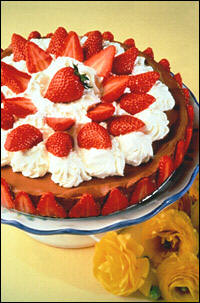
In bowl, mix crumbs and butter to blend thoroughly. Press evenly onto bottom of 9-inch springform or cheesecake pan. Stand strawberry halves, touching, side-by-side, pointed ends up with cuts sides against side of pan. Set aside.
Place chocolate chips in blender container. In small saucepan over medium heat, mix water and corn syrup; bring to boil and simmer 1 minute. Immediately pour over chocolate chips and blend until smooth. Cool to room temperature.
Meanwhile, in large mixer bowl, beat 1 1/2 cups of the cream to form stiff peaks. With rubber spatula, fold cooled chocolate into whipped cream to blend thoroughly. Pour into prepared pan; level top. (Points of strawberries might extend above chocolate mixture.) Cover and refrigerate 4 to 24 hours.
Up to 2 hours before serving, in medium mixer bowl, beat remaining one cup cream to form soft peaks. Add sugar; beat to form stiff peaks. Remove side of pan; place cake on serving plate. Using a Pastry Bag with a star tip pipe or dollop whipped cream onto top of cake. Arrange remaining halved strawberries on whipped cream. To serve, cut into wedges with knife, wiping blade between cuts.
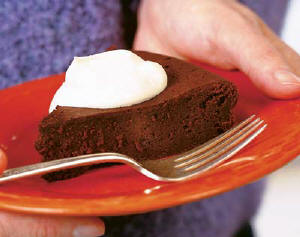
This extremely deep, rich, and dark cake tastes great with whipped cream.
Yield: 10 Servings
5 oz. semisweet chocolate, chopped
3 oz. unsweetened chocolate, chopped
1/4 lb. (8 Tbs.) unsalted butter, cut into pieces plus more for the pan
4 eggs, at room temperature
1/2 cup sugar
1/4 cup brewed espresso or double-strength coffee, cooled to room temperature
1 Tbs. sifted, finely ground espresso beans (from about 1 heaping Tbs. whole beans)
1/4 tsp. salt
1/4 cup all-purpose flour plus more for the pan
Heat the oven to 350 F. Butter an 8-inch cake pan and line the bottom with Pan Liners (parchment). Butter the parchment and lightly flour the pan, shaking out the excess.
In a small, heavy-based saucepan over medium heat, melt the chocolates and butter, stirring frequently. Set aside.
Using the whisk attachment of a stand mixer, whip the eggs, sugar, brewed espresso, ground espresso beans, and salt on medium-high speed until thick and voluminous, at least 8 min. Turn the mixer to low and mix in the butter-chocolate mixture. Turn off the mixer. Sift the flour over the batter and fold until all the ingredients are fully incorporated.
Pour the batter into the prepared pan and bake until a skewer inserted in the center of the cake comes out clean, 25 to 30 min. Cool in the pan on a rack for 10 min. Set a plate over the torte and carefully invert the torte onto the plate; peel off the parchment. Flip the torte back onto the rack to cool completely before slicing.
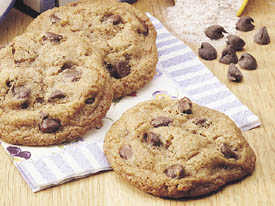
Nothing is more delicious than a warm, chewy chocolate chip cookie. Using whole wheat flour instead of all-purpose makes this a contender for the best-tasting cookie ever!
Yield: 3 dozen cookies
3/4 cup granulated sugar
3/4 cup packed brown sugar
1 cup butter or margarine, softened
1 teaspoon vanilla
1 egg
2 cups Gold Medal whole wheat flour
1 teaspoon baking soda
1/2 teaspoon salt
1 package (12 ounces) semisweet chocolate chips (2 cups)
Heat oven to 375 F.
Mix sugars, butter, vanilla and egg in large bowl. Stir in flour, baking soda and salt (dough will be stiff). Stir in chocolate chips. Feeling a little nutty? Go ahead and add 1 cup coarsely chopped nuts with the chocolate chips.
Drop dough by rounded tablespoonfuls about 2 inches apart onto ungreased cookie sheet.
Bake 8 to 10 minutes or until light brown (centers will be soft). Cool slightly; remove from cookie sheet. Cool on wire rack.
Did You Know? The word cookie comes from the Dutch word for cake, "koekje". The first cookies were actually tiny cakes baked as a test to make sure that the oven temperature was right for baking a larger cake.

 Yield: 12 servings.
 Yield: 10 Servings
 Yield: 3 dozen cookies